


Lina Maria Romero
Project Lead
ENGIE

Fast On‑Site is a mobile, easy‑to‑use and immediately actionable solution that turns complex analysis into an accessible decision‑support tool for everyone.
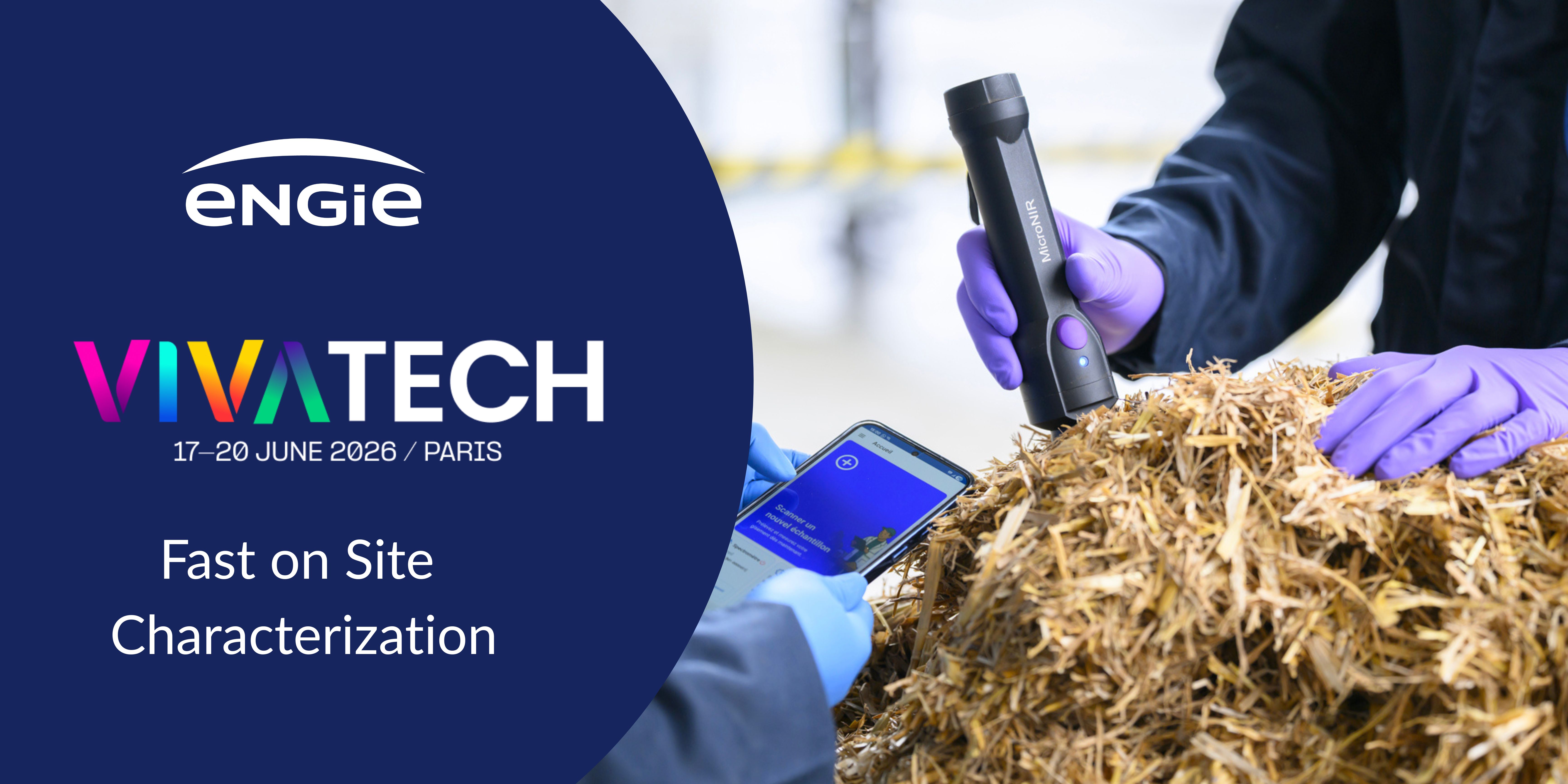
On an anaerobic digestion site, having fast access to reliable information on materials is essential to optimize performance. With Fast On‑Site Characterization, Lab Crigen—one of ENGIE R&I’s research centers—offers an innovative solution enabling the characterization of substrates and digestates in just a few seconds, directly in the field.
By combining near‑infrared spectroscopy and artificial intelligence, this mobile solution turns a complex analytical process into a simple decision‑support tool, enhancing operational performance and supporting the development of renewable gases.
I am an R&D Project Manager within ENGIE’s Biomass, Biogas and Waste laboratory at the Lab Crigen research center.
I work on the Fast On‑Site Characterization project, a solution developed by ENGIE to rapidly characterize, directly on site, the materials used in anaerobic digestion, such as substrates (input materials) and digestates (by‑products of the digestion process).
The solution combines near‑infrared spectroscopy and statistical modeling to predict, within seconds, key parameters used to operate anaerobic digestion plants. The results are accessible via a simple and intuitive mobile application, enabling operators to make immediate, informed decisions.

Our goal is to drastically reduce the time and cost required to analyze materials for anaerobic digestion, while providing operators with reliable, real‑time information to operate their facilities.
The solution provides a portable tool that delivers essential data instantly, directly in the field, thud eliminating the need to send samples to laboratories and wait several days for results.
Our solution targets all stakeholders facing material variability in anaerobic digestion, including:
It is designed to be used directly by field teams, without the need for specific analytical expertise.
Fast On‑Site Characterization provides:
By improving plant operation, the solution helps optimize biomethane production, directly contributing to the greening of gas networks and the reduction of associated emissions.
On the ENGIE stand, we will offer a live demonstration of the solution, showcasing the on‑site characterization of different materials using a portable spectrometer.
The key takeaway: Fast On‑Site is a mobile, easy‑to‑use and immediately actionable solution that turns complex analysis into an accessible decision‑support tool for everyone.
Today, artificial intelligence already plays a central role in the solution. Near‑infrared spectra are interpreted using machine‑learning models that learn the relationships between spectral signatures and the characteristics of organic materials.
In the medium term, integrating new AI tools into the application will allow operators to gradually enrich the database and automatically trigger the creation or updating of predictive models. This approach will enable continuous adaptation of models to real‑world use cases, while reducing manual recalibration efforts and improving prediction robustness.
The main challenge is scaling up: making the solution increasingly robust in the face of material diversity, supporting its deployment across a large number of sites, and embedding it sustainably into operational practices.
If Fast On‑Site Characterization fully delivers on its promise, it will have helped accelerate the development of green gases by making anaerobic digestion plants more flexible, responsive, and efficient.
The solution will facilitate the integration of new feedstocks and continuous process optimization, making anaerobic digestion an even stronger lever for the energy transition.
Photos (c) Franck Dunouau, 2026