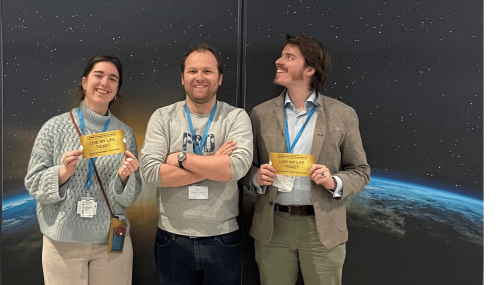

Sébastien Vinant
Project Director
ENGIE

this solution, designed with field stakeholders, is built on a strong partnership approach with the agricultural sector, aiming to simplify processes and make exchanges more fluid.
Showcased on the ENGIE booth at SPACE 2026 after VivaTech, MetaNow demonstrates how new business models can transform practices across a sector at the heart of the energy transition.
Sébastien Vinant, Project Director within ENGIE R&I’s Acceleration Studio and Head of the MetaNow offering, shares more insights.
The agricultural waste sector currently lacks a structured market that would enable stakeholders to properly valorize their production under optimal conditions. MetaNow is a solution designed to engage biomethane feedstock suppliers through a simple and transparent participatory mechanism, ensuring end-to-end traceability of the sustainability of the biomethane produced.
In the long term, the solution will not only facilitate exchanges between anaerobic digestion operators and feedstock suppliers, whether agricultural or industrial, but also improve risk management upstream of projects and during the operational phase.
Anaerobic digestion is primarily a way to process organic waste from agriculture or the agri-food industry, capture and utilize the methane it releases, and produce a fertilizer that can replace petrochemical-based fertilizers.
One of the key challenges in developing anaerobic digestion is connecting these waste producers with digestion plants within a local ecosystem. This is precisely what MetaNow aims to enable, seamlessly and transparently.
Our clients are anaerobic digestion plant operators. Users include farmers, agri-food industry players, and procurement and agricultural business development teams working for these operators.
MetaNow accelerates the sourcing of feedstock for both existing and planned anaerobic digestion units, as well as the identification of land for digestate application in the development of new facilities.
The solution enables stakeholders to engage more efficiently, delivering significant time savings and reducing process errors, particularly through the automated analysis of administrative documents.
We will present an initial module of the solution dedicated to:
That this solution, designed with field stakeholders, is built on a strong partnership approach with the agricultural sector, aiming to simplify processes and make exchanges more fluid.
The module dedicated to identifying land for digestate application uses generative AI to analyze administrative documents, often dozens of pages long, and extract key parcel characteristics and environmental constraints.
In the future, AI will be further integrated across the solution to simplify and accelerate data management.
The module presented at VivaTech last year enabled us to launch field testing. User feedback has led to the development of new features, helping them become more efficient in their daily activities. To date, several hundreds hectares of crops have been managed through the platform.
Our next steps include deploying this first module in France, along with developing a second module dedicated to price analysis, influencing factors, and risk management across the supply chain.
At our scale, our solution will have contributed to the growth of renewable gas and to the increased use of organic fertilizers as a substitute for fossil-based fertilizers.




![[VIDEO] ENGIE Serving on the Jury for High-Impact Eco-Innovative Cleantech Solutions](https://innovation.engie.com/uploads/articles/500_285/6ad87f885ed5b-ENGIE-Clean-Tech-Open.jpg)