Joachim Labauge
Head of CO₂ Development
Elengy

The GOCO₂ project aims to avoid more than 2 million tonnes of CO₂ emissions per year—equivalent to the annual emissions of the Nantes metropolitan area.
Presented at VivaTech on the ENGIE stand, the GOCO₂ project demonstrates how existing infrastructure can be transformed into enablers of the energy transition. Building on the Montoir-de-Bretagne LNG terminal, the initiative offers a complete CO₂ value chain, from capture to geological storage.
Beyond technical performance, GOCO₂ embodies a clear ambition: to help shape a French industry that reinvents itself, innovates, and actively contributes to carbon neutrality.
Joachim Labauge, Head of CO₂ Development at Elengy, answers our questions.
The GOCO₂ project, showcased on the ENGIE stand at VivaTech, is part of a broader effort to support industrial decarbonisation, particularly around our existing LNG terminals.
Its objective is to help industrial players in western France transition by enabling them to capture CO₂ emissions and transport them to permanent geological storage sites. For certain sectors, this capture and storage strategy is now essential to reducing emissions.
GOCO₂ is built around two large cement plants located in western France: Lafarge in Mayenne and Heidelberg Materials in Deux-Sèvres. Within the Group, Natran is responsible for developing the pipeline that will connect these sites to the Montoir-de-Bretagne LNG terminal, operated by Elengy.
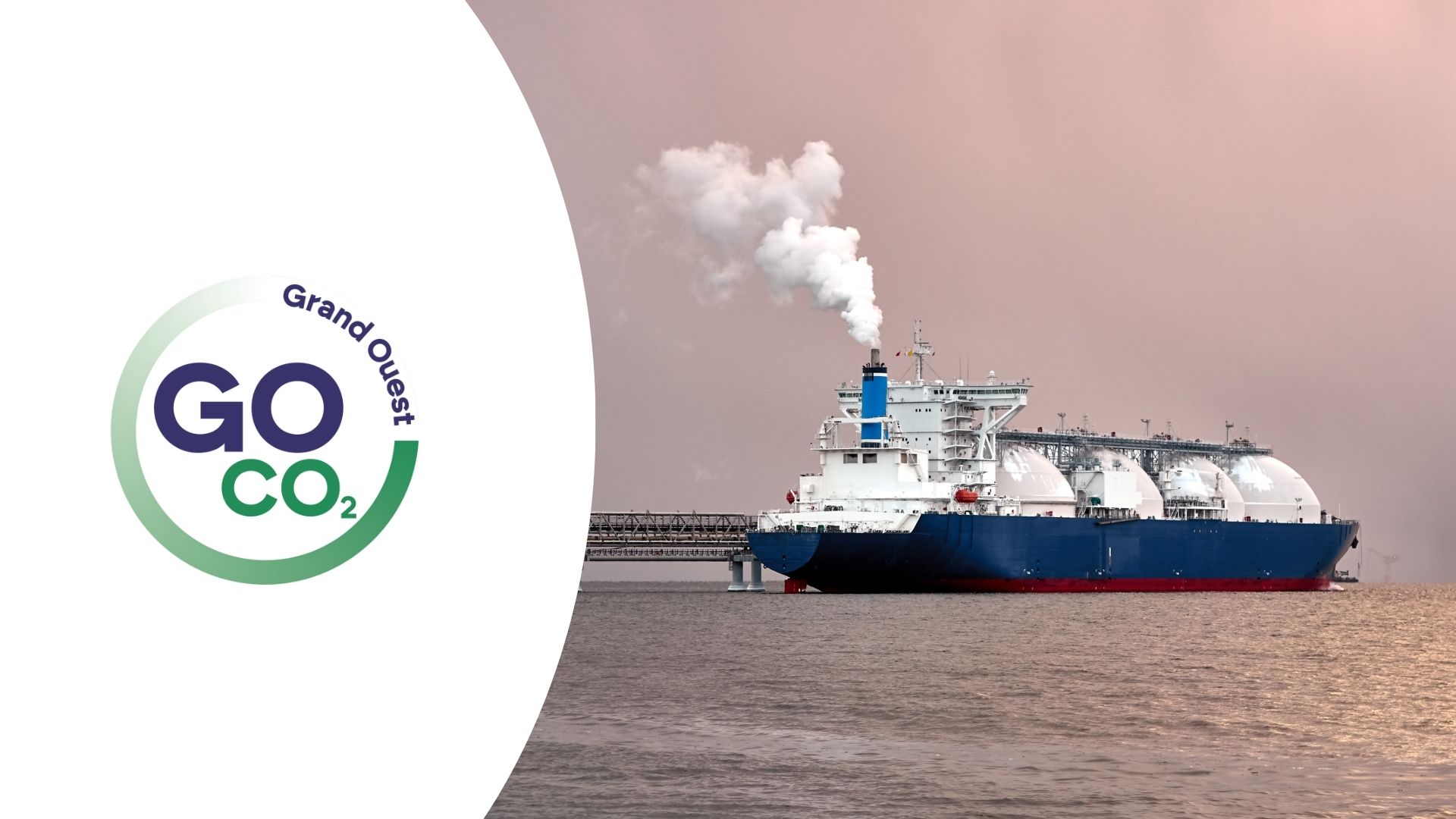
Currently dedicated to liquefied natural gas (LNG) imports, the terminal is set to evolve to incorporate CO₂ liquefaction and loading capabilities. The CO₂ will then be transported by sea to storage sites, particularly in the North Sea.
For Elengy, GOCO₂ consists of developing an integrated CO₂ liquefaction and export infrastructure, serving a complete decarbonisation value chain. While the project primarily addresses the needs of major emitters, it also opens the door to a more circular approach, eventually enabling connections between CO₂ emitters and users.
This project perfectly illustrates our ability to leverage existing expertise. The terminal’s core activity involves receiving LNG at -160°C and regasifying it—a process that releases significant amounts of cold energy. Conversely, CO₂ liquefaction requires energy. By coupling these two processes, we can use the cold from LNG to liquefy CO₂, thereby reducing overall energy consumption through process integration.
In short, GOCO₂ is about putting our expertise and infrastructure to work for a more decarbonised industry.
The project primarily addresses the decarbonisation needs of cement producers, each emitting around one million tonnes of CO₂ per year.
In this sector, nearly two-thirds of emissions are not linked to fuel combustion, but to the chemical transformation of limestone into cement. This process releases so-called “unavoidable” CO₂, for which no direct alternative currently exists. In this context, carbon capture and storage emerges as the only viable solution for reducing these emissions. GOCO₂ fits precisely into this approach by offering a complete transport and storage chain.
The two cement manufacturers act as “anchor emitters,” providing the volumes needed to launch the project. However, the infrastructure is designed to progressively open up to other players, particularly smaller regional emitters.
It also creates opportunities for CO₂ valorisation, fostering the emergence of a genuine regional carbon economy as infrastructure expands.
The GOCO₂ project aims to avoid more than 2 million tonnes of CO₂ emissions per year—equivalent to the annual emissions of the Nantes metropolitan area.
Beyond this direct impact, it helps structure a complete carbon capture, transport, and storage value chain, which is essential for decarbonising hard-to-abate industrial sectors. (Learn more at concertation.GOCO₂.fr)
We will showcase a model illustrating both existing LNG facilities and future CO₂ infrastructure, along with their interconnections.
This will help visualise the energy synergies between the two systems—particularly the use of LNG cold energy for CO₂ liquefaction.
We want to demonstrate that deindustrialisation is not inevitable in France. Many industrial players are fully committed to the transition and are working to build a decarbonised, competitive, and locally rooted industry.
GOCO₂ is a concrete example of this: it shows how existing infrastructure, originally dedicated to fossil LNG imports, can evolve into a powerful decarbonisation lever.
This transformation is both innovative and forward-looking.
Like any large-scale infrastructure project, GOCO₂ faces significant financial, organisational, and industrial challenges.
The required investments are substantial: cement producers must finance capture units, Natran the pipeline, and Elengy the new terminal facilities.
A key issue lies in the economic viability of the model. Today, industrial players can still choose between investing in decarbonisation or continuing to emit CO₂ while paying for carbon allowances, currently priced at around €70–80 per tonne. For such projects to become attractive, either carbon prices must increase or technology costs must decrease. That said, the project has already received significant public support, helping to bridge the economic gap and enable more favourable investment decisions.
Another major challenge lies in coordinating all stakeholders: for the project to succeed, every link in the value chain must progress in parallel, with strong technical, financial, and operational alignment.
It is an ambitious and complex project—but also an extremely exciting one.
Even as uses evolve, cement will remain an essential material—particularly for infrastructure supporting renewable energy. It is therefore crucial to make it compatible with climate objectives. With GOCO₂, we will have access to low-carbon cement, with significantly reduced CO₂ emissions released into the atmosphere.
In the longer term, such infrastructure could help create a true regional CO₂ ecosystem, including opportunities for reuse and even negative emissions through biomass-based CO₂.