


Laurent Bourgouin
Co-founder and CEO
Samp

The recent surge of agentic AI in our industry has further highlighted the critical issue of data quality on industrial sites
By combining 3D capture and artificial intelligence, Samp creates a shared workspace that is reliable and continuously updated. A major step forward to improve operational performance, enhance safety, and make industrial sites more agile in addressing the challenges of the energy transition.
We spoke with Laurent Bourgouin, CEO and co-founder of Samp, to understand how this innovation paves the way for a more resilient, data-driven industry.
For over 20 years, I have worked in the process industry, mainly in water and energy. Six years ago, together with my partner Shivani Shah, we founded Samp to help industrial players better prepare all maintenance, modernization, and decarbonization activities on their sites.
For the past 20 years, I have consistently observed how technical documentation on industrial sites—such as drawings, schematics, and inventories—is almost never up to date. This is simply because industrial sites are constantly modified by multiple stakeholders, often subcontractors, and documentation updates fail to keep pace.
The result is significant inefficiency in on-site operations, major safety concerns, and an inability for the industry to transform at the speed required to address current sustainability and supply challenges.
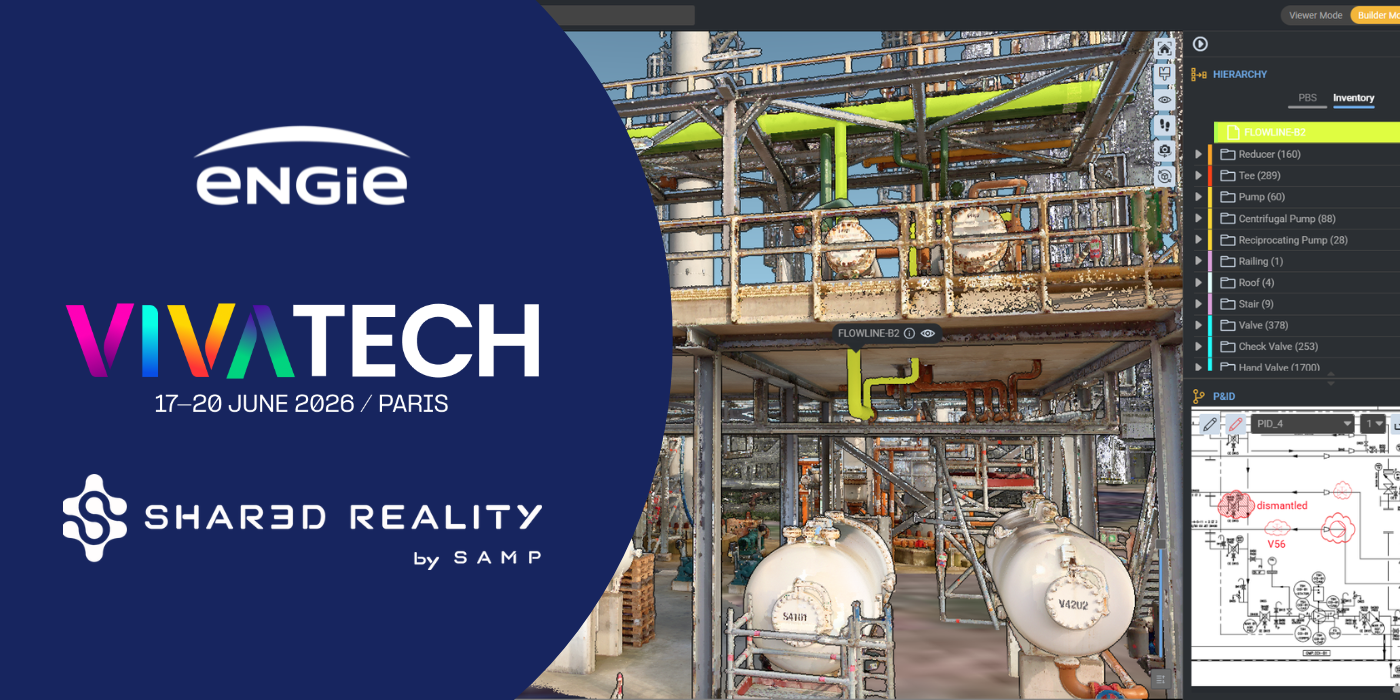
Our patented solution leverages fully proprietary artificial intelligence to reconcile all technical documentation with a 3D capture of the site’s physical reality. This creates an online 3D workspace enriched with validated and aggregated business data.
This environment, which we call Shared Reality, is shared with all stakeholders who need reliable, contextualized information to prepare any on-site activity (maintenance, inspection, construction work, etc.).
Samp has now become an international company, operating across Europe and North America. We support more than 500 industrial sites for major players in water and energy, such as ENGIE, Veolia, Suez, ExxonMobil, TotalEnergies, and ConocoPhillips.
The recent surge of agentic AI in our industry has further highlighted the critical issue of data quality on industrial sites. Many large industrial players are seeing their first deployments of agentic AI fail in real-world site environments.
This is not because AI models themselves are flawed, but because they rely on technical documentation as input. When this documentation is incomplete or inaccurate, it leads to what we call “operational hallucinations,” which can have serious consequences.
The only solution is to feed these AI systems with the most reliable data source available: the field itself. That is precisely what our Shared Reality solution does—transforming 3D scans of industrial sites into structured, contextualized data that can be used by humans, AI models, and soon even robots.
Since its launch, Samp’s DNA has always been about making our industry more resilient. We firmly believe that the ecological and energy transition requires industrial sites to become more adaptable and flexible.
Our mission at SAMP is to contribute to this resilience by providing plants with the tools and data they need to adapt almost in real time to evolving safety, sustainability, and supply constraints.