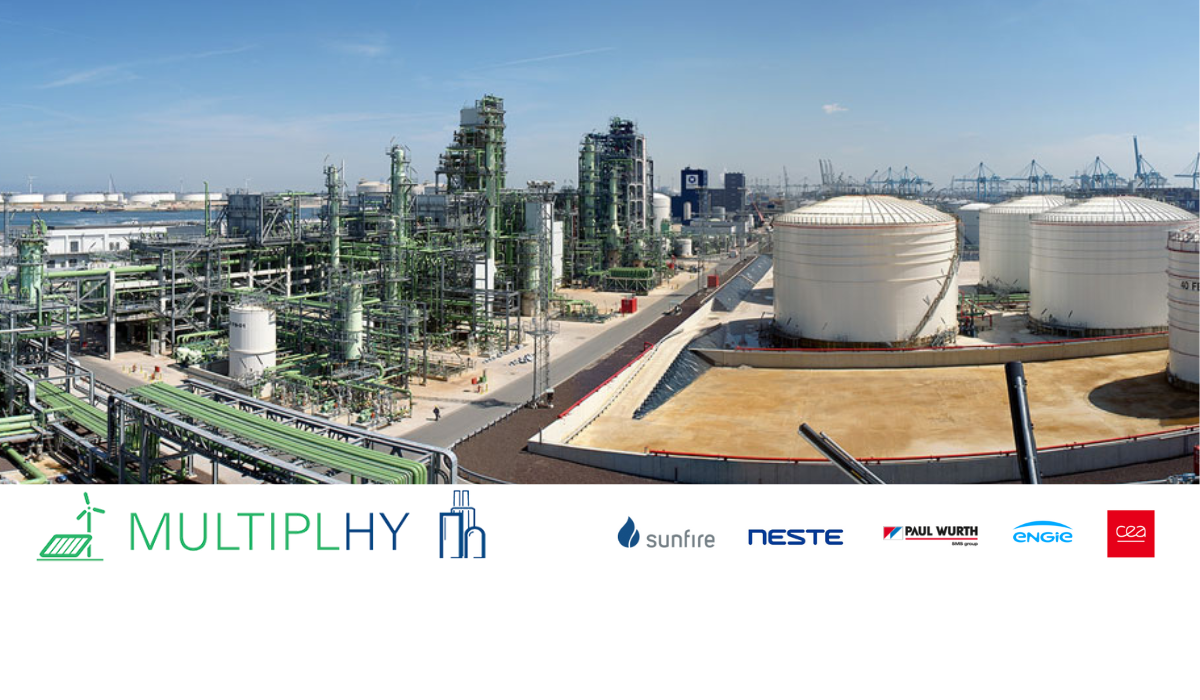
The partners of the MultiPLHY consortium have successfully commissioned the world's largest high-temperature electrolyser (HTE) in an industrial environment, at Neste's renewable products refinery in Rotterdam, the Netherlands. This pilot aims to demonstrate the viability of renewable hydrogen to reduce the use of fossil hydrogen in the refining industry.
Replacing hydrogen produced from fossil raw materials with renewable hydrogen is one of the key means to lower greenhouse gas emissions in refining. As a next step in the demonstration project, a test program will validate the technology's performance characteristics.
Neste is responsible for the refinery integration and together with Sunfire oversees the operation of the unit. The research and technology organization CEA coordinates the project and ENGIE is in charge of techno-economic assessment.
« High-temperature electrolysis has the potential to make renewable hydrogen more affordable while increasing the energy efficiency of various industrial processes globally. The construction and commissioning achieved by Sunfire and Neste is a tremendous achievement and a big step in making green hydrogen competitive,” enthusiastically emphasises Estibaliz Gonzalez-Ferrer, Director of the CRIGEN Lab at ENGIE R&I.
This MultiPLHY project has received funding from the Fuel Cells and Hydrogen 2 Joint Undertaking (now Clean Hydrogen Partnership) under grant agreement No 875123. This Joint Undertaking receives support from the European Union's Horizon 2020 research and innovation programme, Hydrogen Europe and Hydrogen Europe research.
(1) Electrical efficiency of 84 % LHV/AC proven in EU-funded GrInHy2.0 project in 2022 with 1st generation of Sunfire’s SOEC electrolyzers. Expected efficiency of 89% LHV/AC of the 3rd generation of Sunfire’s SOEC electrolyzers.