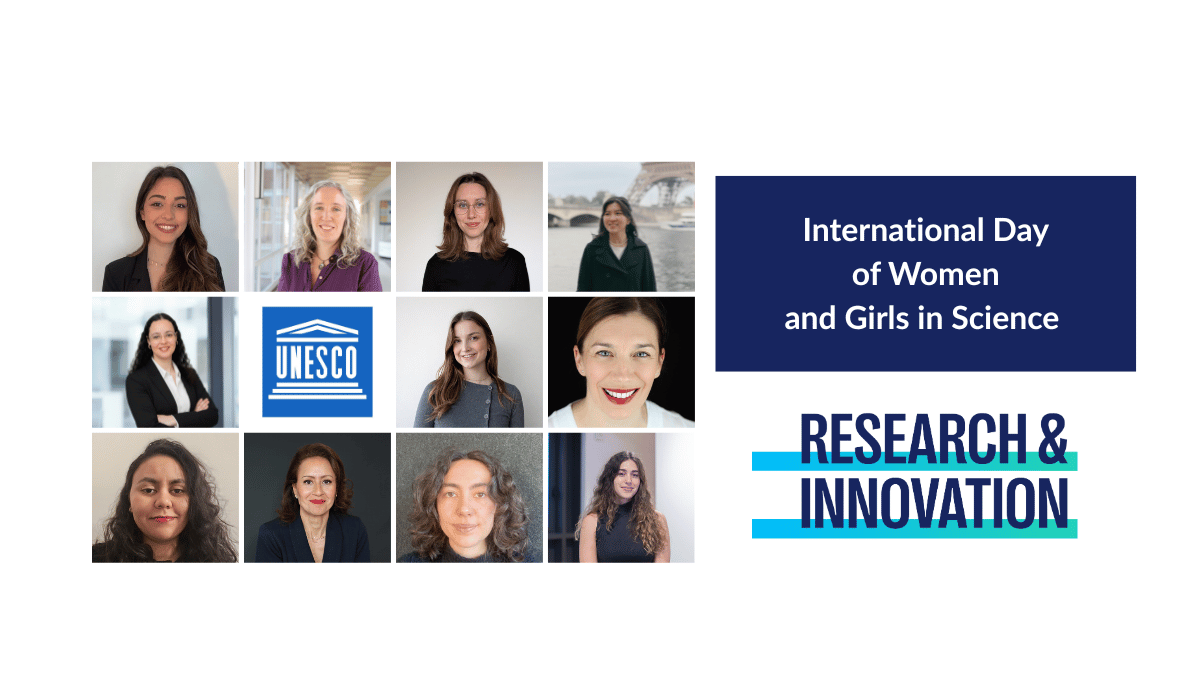
To mark this day, celebrated on Wednesday 11 February, we invited several young women from R&I to share, in a few words, what led them to choose a scientific path.
Whether they are PhD candidates, engineers or team managers, each of them follows a unique journey. What they all have in common is the conviction that a passion for science can open inspiring life paths and empower us to shape the future.
We are delighted to share their testimonies.

Fiona Buckley is a Senior Expert and Senior Project Manager at ENGIE Laborelec, where she leads and contributes to several major European projects focused on integrating renewable energy sources — particularly tidal and wind — with a range of storage solutions.
Alongside these project responsibilities, she also coaches and supports colleagues, ensuring that their technical developments are aligned with ENGIE’s strategic priorities and operational needs. This dual position enables her to drive innovation while strengthening and developing expertise within the teams.
Fiona, why did you choose a scientific field?
I chose a scientific field for the same reason I’ve always loved puzzles and/or chess: the challenge to look beyond the obvious, to think several steps ahead, and to stay calm when it gets complicated. In science, progress comes from curiosity, patience, and the belief that every small move — every question, every experiment — brings you closer to a meaningful solution. That blend of strategy, discovery, and purpose is what inspires me every day.

Valencia Nyoto is a PhD candidate at Lab Crigen. Her thesis focuses on the evolution of the performance of low-temperature electrolysers depending on their operating profile, combining experimental measurements and modelling approaches.
Valencia, why did you choose a scientific field?
Out of curiosity, but also because I found a space where I could ask questions, look for answers, and build things by myself.

Hanine Ibrahim is a PhD candidate at Lab Crigen. Her thesis focuses on optimising a purification chain for syngas produced by the pyro-gasification of residues and waste, particularly through the adsorption of gaseous pollutant traces.
Hanine, why did you choose a scientific field?
My desire to understand today’s challenges and to contribute to building sustainable solutions naturally led me towards science. For me, it is a way to take concrete action, innovate, and address environmental and societal challenges.

Camille Breuzin is a PhD candidate at Lab Crigen. Her thesis focuses on “Nitrogen mineralisation in anaerobic digestion: understanding mechanisms and impact on biogas production.” The objective is to limit process inhibition caused by ammoniacal nitrogen, improve digestate valorisation, and reduce environmental impacts related to nitrogen losses.
Camille, why did you choose a scientific field?
First out of passion and curiosity, which then gave me the desire to contribute to innovative and sustainable solutions that have a positive impact on society.

Marthe Picard is part of the Nuclear Chemistry Team at Laborelec, where she works on various topics such as primary chemistry, radiological measurements, and the decommissioning of nuclear sites.
Marthe, why did you choose a scientific field?
I have always been interested in “how things work”, and by turning that knowledge into something useful, I can fulfil my desire to have a positive impact, particularly in the field of energy and sustainability.

Sandra Sleiman is very sensitive to environmental challenges and innovation. She is pursuing a Master’s degree in Energy at Mines Paris – PSL, while completing an apprenticeship within the Innovation & Engagement team at ENGIE R&I.
Sandra, what led you to choose a scientific field?
I’ve always been fascinated by how things work and how science can solve concrete problems. For me, it is an opportunity to combine curiosity, creativity and critical thinking to have a positive impact.
As a woman in science, I want to show that passion and determination have no gender.

Elodie du Fornel is Lead Scientific Advisor at ENGIE R&I.
She works on prospective technology scouting and strategic research partnerships focused on accelerating the energy transition, identifying emerging trends and fostering collaborations that shape ENGIE’s long-term innovation roadmap.
Elodie, why did you choose a scientific path?
Because I’ve always been fascinated by how the world works, and I believe that understanding nature is the key to creating progress. For me, science is a way to turn curiosity into real, positive change and to develop innovations that truly benefit society.

Téma Benhalima‑Bouville is Group Innovation Director at ENGIE.
Téma, why did you choose a scientific field?
As a child, I spent hours browsing through a children’s science encyclopedia… fascinated by the solar system, atoms, the H‑bomb, magnets, Newton’s apple…
I quickly developed a deep admiration for Albert Einstein and Marie Curie — they became my idols.

Sirine Rahali is an apprentice within the Innovation & Engagement team at ENGIE R&I. She holds degrees in Energy Systems and Markets (Grenoble INP – Ense3) and Industrial Engineering (ENIT Tunis). She is currently pursuing a specialised Master’s degree in Responsible Technological Innovation Management at Grenoble Ecole de Management to strengthen her technical expertise and develop a broader vision of innovative project management.
Sirine, why did you choose a scientific field?
I chose a scientific field to understand, analyse and take action. Science gives me the tools to have a concrete impact on complex projects, particularly in the energy sector.

Hajar Smirni is an energy efficiency engineer at Lab Cylergie, where she contributes to the analysis, optimization, and development of technical solutions aimed at reducing energy consumption and improving the overall performance of systems.
Hajar, why did you choose a scientific field?
My choice for science came naturally, driven by my interest in its concrete impact on our ways of living.
I was then attracted to energy engineering for its strong focus on innovation, where every advancement helps push technological boundaries and address today’s environmental challenges.

Chloé Vandelois works at Laborelec as a chemical engineer in the nuclear field, focusing on water chemistry and the management of nuclear waste.
Chloé, why did you chose a scientific field?
I have always been curious about how the world works. Science gives me the opportunity to ask questions, solve real problems, and keep learning every day. What motivates me most is the real world impact of science, helping improve technologies and build solutions for future energy and environmental challenges.