
Janis Klavins
Sr. Account Executive
Aerones

Areones chose to work and innovate with ENGIE because of ENGIE’s global scale in energy infrastructure, strong focus on decarbonization, and commitment to digital transformation.
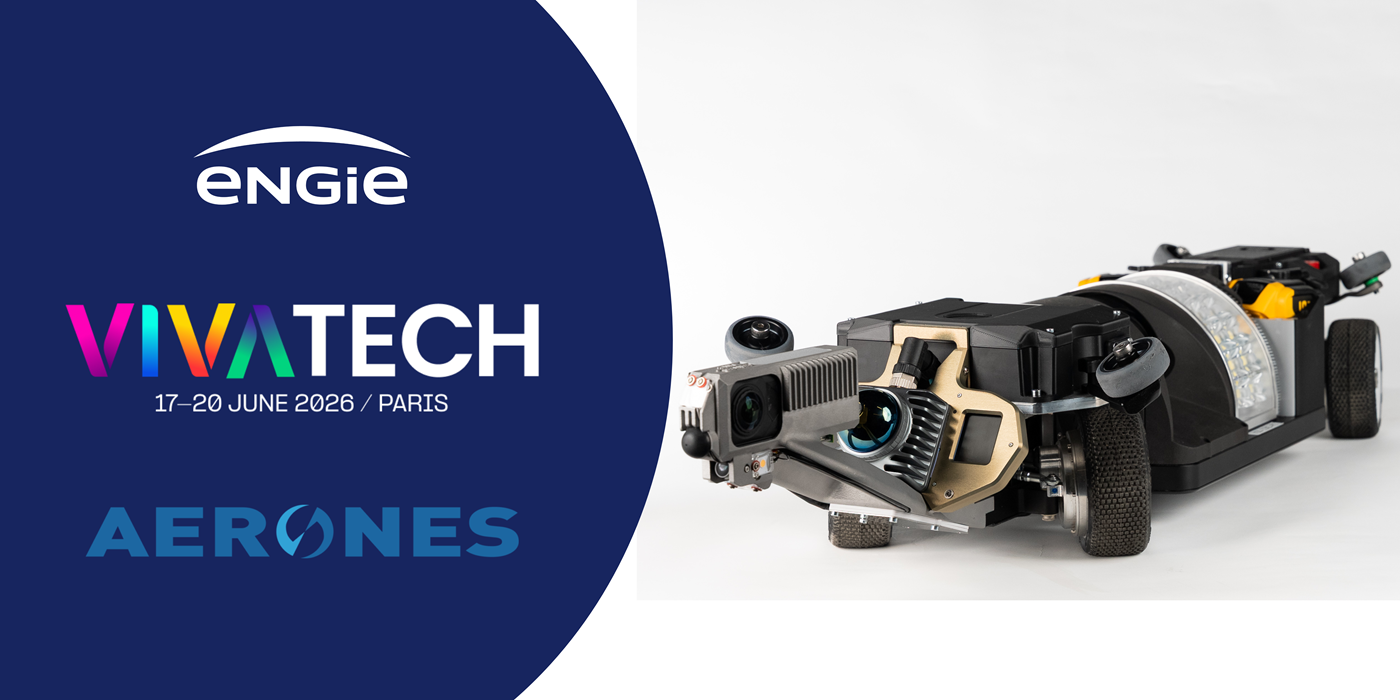
Working with ENGIE since 2024 across Europe and the United States, Aerones is now bringing its Gen 3 internal inspection crawler to the ENGIE booth at VivaTech — a tangible demonstration of how AI can deliver impact through safety, performance and predictive maintenance.
My name is Jānis Kļaviņš, Sr. Account Executive for Aerones. Aerones is a robotics and AI company founded in 2018 in Riga, Latvia, with a second hub in Dallas, Texas. We are the world's leading provider of robot-enabled wind turbine inspection, maintenance, and repair services. Our customers - including NextEra, GE Vernova, Vestas, Enel, and Siemens Gamesa - represent more than 50% of the world's installed wind capacity, and we operate across more than 35 countries.
Our mission is straightforward: keep the world's wind turbines producing clean energy at peak performance, for longer, with less risk to the people who maintain them.
Wind turbines are among the tallest moving mechanisms on the planet, and keeping them healthy still depends on technicians dangling from ropes dozens of meters in the air - a model that is too slow, too dangerous, and far too understaffed to support the energy transition. In plain language: we send robots up the turbines so humans don't have to, and we do it with speed and quality that manual work can't achieve.
Three things.
Aerones has been actively working with ENGIE in Europe and the United States since 2024, doing hundreds of robotic internal blade and LPS inspections and several leading edge repair projects. Our main collaborators at ENGIE have been Nicolas Quiévy, Pragna Martin, and Jeremy Hellot. Areones chose to work and innovate with ENGIE because ENGIE’s global scale in energy infrastructure, strong focus on decarbonization, and commitment to digital transformation create an ideal environment for deploying advanced autonomous inspection and maintenance technologies. The partnership enables Areones to validate and scale its robotics solutions across real-world industrial assets while helping ENGIE improve safety, operational efficiency, predictive maintenance, and sustainability outcomes.
Aerones will be showcasing our Gen 3 internal inspection crawler for wind turbine blade inspections.
One key takeaway we want visitors to remember is that Aerones is transforming wind turbine maintenance with robotics that make inspections safer, faster, and more data-driven. Our Gen 3 internal inspection crawler demonstrates how innovation can reduce downtime, improve asset reliability, and help accelerate the future of clean energy together with ENGIE.
AI is not a marketing layer for us - it sits at the core of every robot we deploy, and every operation we execute. Today it powers automated defect detection on blade imagery (identifying cracks, erosion, and delamination at sub-millimeter resolution), precision control of our repair and coating robots, and predictive analytics that tell wind farm operators which turbines need attention before failures occur.
Where we're heading: greater autonomy for the robots themselves, so a single operator can supervise multiple turbines simultaneously, and predictive models that move the industry from reactive repair to true condition-based maintenance. Our operations hub relies heavily on AI models that optimize route planning, weather conditions, expenses and the materials used in various projects. Every AI feature we ship has to translate into a measurable outcome: megawatt-hours recovered, downtime reduced, or a technician kept safely on the ground.
Two challenges, running in parallel.
Short term: scaling our U.S. operations out of the new Dallas hub to meet North American demand, and bringing our offshore service capability to commercial scale, which is technically and logistically much harder than onshore.
Medium term: optimize our core processes using AI-enhanced software solutions and industrializing our robotic Leading Edge Repair system so it can be deployed at the volume the global fleet actually requires. The wind industry is staring down a serious technician shortage by 2030, and our challenge is to scale robotic capacity fast enough to close that gap.
Three concrete shifts.
Meet Aerones on ENGIE's Booth at Viva Technology on June 17-20 and learn more about them watching this video: