
Our solutions are being used at two ENGIE sites to recover CO₂ and liquefy gas, and we will soon be working at two other sites.
CryoCollect is a startup that I founded with Philippe Khairallah in 2017. Our aim was to develop technologies in the field of biogas, and then the treatment of gas in general. In 2018, we set up the first biomethane liquefaction system (BioLNG) in France. That same year, we started thinking about the treatment of carbon dioxide (CO₂) released by methanation. And in 2020, we developed the first system capable of purifying the lean gas released by methanation to produce food-grade liquid CO₂.
This process reduces the volume of the gas by a factor of 600, making it easy to store and transport. Moreover, liquefied biomethane, or bioLNG, can be used as a fuel in the same way as natural gas. It is even more efficient than CNG (compressed natural gas). In addition, the local production of bioLNG strengthens our energy independence by using energy that is locally produced.
To explain it to you, I'll go back to the origins of biogas and explain what methanation is: it's a natural biological process of degradation of animal or vegetable organic matter, which, as it ferments, releases gas. For example, methanation is used to recover organic waste (slurry, manure, harvest residues, etc.) produced by farmers. This raw material is passed through a methane digester, a sort of large tank that mixes and "digests" it, rather like a stomach. Bacteria will ferment this raw material, producing a biogas made up of methane and CO₂. For this biogas to be useable, it has to go through a purification stage, i.e. separating the good gas, with at least 96.5% methane, from the lean gas. Only the first can be injected into the national grid and used as household gas: this is biomethane. The rest is generally released into the atmosphere untreated. But this “lean” gas contains a lot of CO₂. This is the flow that our solution is designed to capture. We purify and liquefy it, producing not only biomethane but also BioCO₂, a renewable, food-grade CO₂ that can replace the fossil CO₂ used in a wide range of industrial applications, such as carbonating beverages or enhancing photosynthesis of tomatoes in greenhouses. It took us five years of research to develop this purification process.
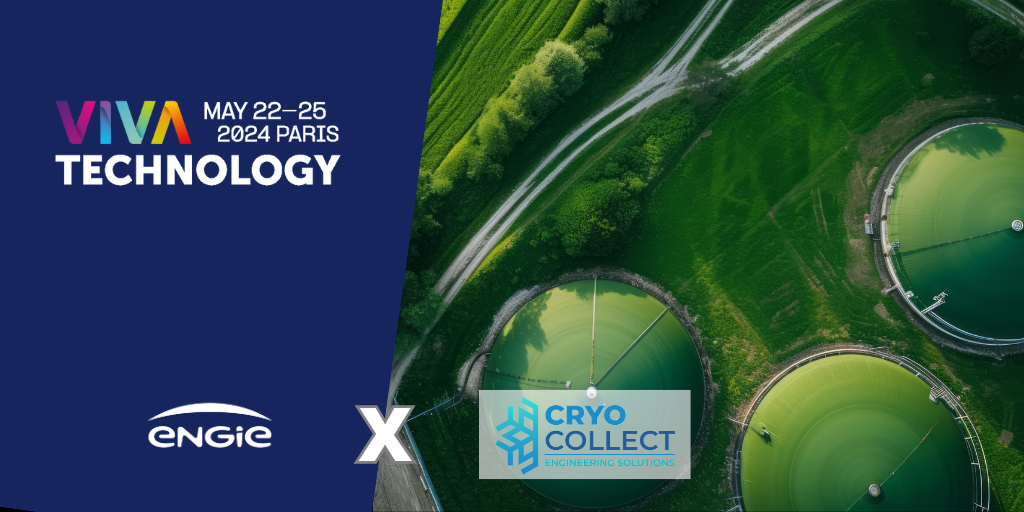
We shall display a scale model showing the ecosystem we have created, with a farm producing organic waste, a methane digester, our CO₂ purification module and our biomethane liquefaction module.
Our ties are strong: ENGIE will be investing in CryoCollect, and is also one of our customers. Today, our solutions are being used at two ENGIE sites to recover CO₂ and liquefy gas, and we will soon be working at two other sites. We are in the process of developing a strategic partnership to provide ENGIE with a solution that will enable it to recover the CO₂ and methane that remains in the CO₂ gas. Today, when we install our process on methanation sites, we are able to recover and treat 100% of the molecules produced.
The first that springs to mind is electricity , which has totally revolutionised our world. It is one of the fundamental pillars of modern civilisation. It has transformed society, enabled countless technological innovations, and in doing so has significantly improved our quality of life. In short, electricity is much more than a simple scientific discovery; it embodies human progress and the possibility of a better, more sustainable future for everyone.
Thanks to ENGIE's investment and the development of the market we've created, we're in a phase of exponential growth. We have deployed our processes at the first nine sites in France to recover CO₂. On the European market, and even in North America, there is no equivalent offer to ours, so we have a huge potential for growth. In fact, we are in the process of establishing a partnership with a major American biogas player to deploy our technology. In this business, Europeans are ahead of the curve, both in terms of standards and culture. We are also currently developing other technologies in-house. Our process can be adapted to gas boilers. We're working on a project called CHOC (zero-carbon boiler), which aims to recover all the CO₂ produced at the level of boiler exhaust flues. We could also decarbonise maritime transport. The market is opening up, and we need to prepare for these opportunities.