
/
My account person ENGIE

My notifications

News See all the news
Innovation in wind power: robots used to repair wind turbine blade erosion

Innovation in wind power: robots used to repair wind turbine blade erosion

At a time when safety and operational performance are becoming major challenges, drones and robots are profoundly transforming industrial practices. Through its “Yes I Do” open innovation workshops, ENGIE R&I is highlighting these technologies that are revolutionising the surveillance, inspection and maintenance of our infrastructure. The numerous use cases shared by the Group’s teams are already demonstrating their tangible impact on safety, efficiency and the reduction of human risks.

The solution proposed by Aerones uses a drone and represents a break with traditional methods and offers many advantages:

For ENGIE, the adventure continues: new inspection and repair campaigns are planned for 2026.

Nicolas Quiévy

Nicolas Quiévy, Wind Technology Manager within the R&F GBU and wind energy expert at the ENGIE Group, presents a solution developed by the Latvian start-up Aerones, which specialises in robotised inspection and repair of wind turbines.

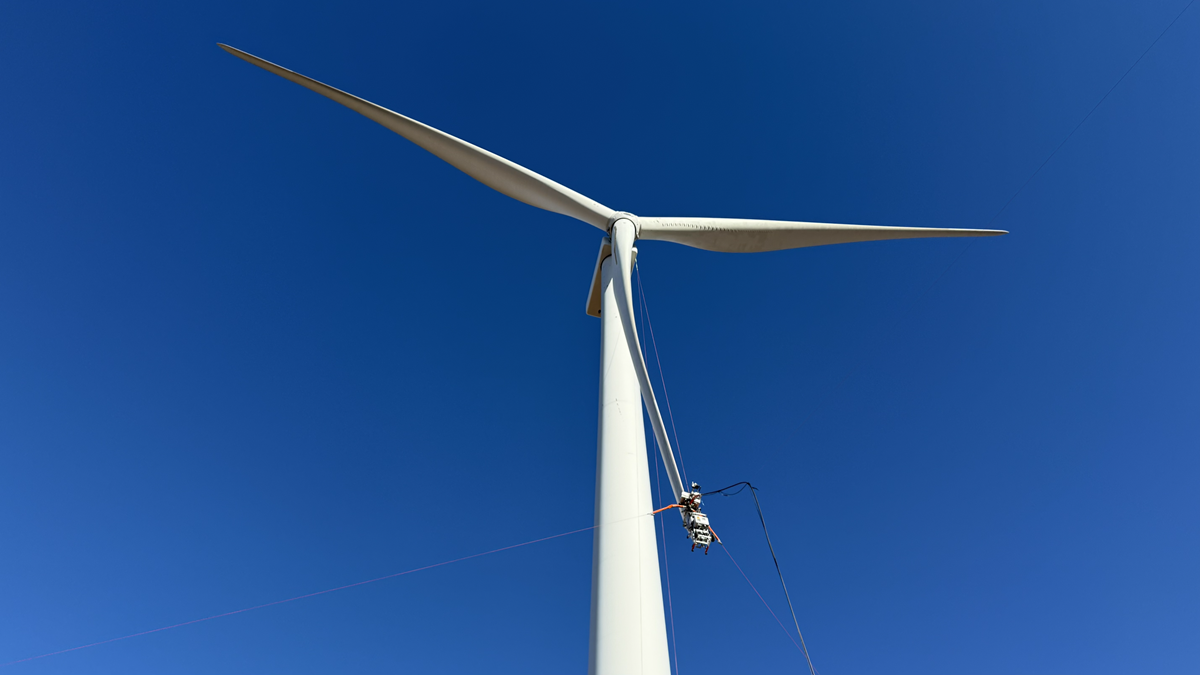
ENGIE Green and ENGIE NORAM have conducted field trials at the Bétheniville (France) and Seymour Hills (USA) wind farms, focusing on the robotised repair of erosion on the leading edge of blades.

What is leading edge erosion?

Leading edge erosion is a common problem on wind turbine blades.

It is caused by the repeated impact, at speed, of particles, mainly drops of rain, with elevated kinetic energy.

Consequences:

  • Gradual degradation of the blade surface;
  • Loss of aerodynamic performance of the blade, and subsequently of the wind turbine;
  • Damage to the blade structure (splitting of layers of material).

All blades are subject to this phenomenon throughout their lives and must be repaired, sometimes several times.

How do we currently repair erosion?

Three traditional methods are used:

  • Rope access technicians: manual work at height, time-consuming and dependent on wind conditions. This method is not authorised in all countries.
  • Suspended platforms: a platform running around the blade. This is a more stable solution, but one that is complicated to put in place.
  • Cherry pickers: can only be used on reasonably sized blades. Increasingly limited as the height of wind turbines increases.

For example: for a 55 m blade (2 MW onshore wind turbine) with average erosion, a conventional repair takes 5 to 9 days, depending on the technique used and the wind conditions (stops from 8–12 m/s).


Aerones: a quicker, more efficient robotic solution

The solution proposed by the start-up Aerones uses a drone and represents a break with traditional methods. It has a number of advantages:

  • Rapid deployment
  • Work can be done in wind conditions comparable to other techniques
  • Much quicker repair

However, it is not suitable for very severe erosion that requires deeper reconstruction of the blade profile.

Feedback from ENGIE in Bétheniville

The experiment involved a 2 MW wind turbine, with a blade length of 55 m.

  • Portion repaired: 10–15 m (the most exposed area)
  • Duration: 30 to 35 hours
  • Estimated cost: €13,000 per turbine, significantly less than conventional methods

 How does the Aerones robot work?


The robot is raised using a winch system and comes into contact with the blade using articulated arms. The robot has a fixed head to which several modules are successively connected to carry out the following actions:

Grinding to remove damaged areas

  • Surface cleaning
  • Application of putty to obtain the right blade profile 
  • Light sanding to prepare the surface
  • Surface cleaning
  • Application of the leading edge protective coating

The robot is operated manually, and all operations are recorded, enabling detailed repair data to be collected.

What is ENGIE’s relationship with Aerones?

ENGIE has been following Aerones since 2017, and has commissioned it to carry out a number of one-off projects, including inspections.

The start-up offers a wide range of services:

  • Drones, robots and crawlers for inspections,
  • Cleaning of blades and towers,
  • Leading edge and other specialist repairs,
  • Inspection of the lightning protection system.

It already has a strong presence in Europe and North America, and continues to grow.

For ENGIE, the adventure continues: new inspection and repair campaigns are planned for 2026.

Aerones will be present at Vivatech 2026 in Paris on the ENGIE stand.


Other news on related topics

Loading...