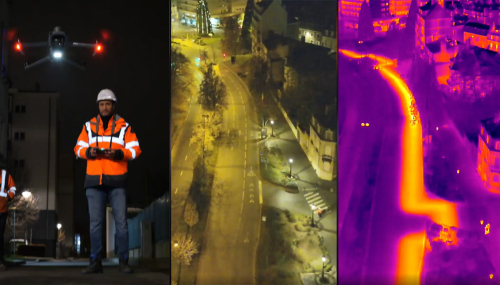


To address the maintenance challenges, SHEM launched a testing programme using first underwater robots, and later aerial robots.
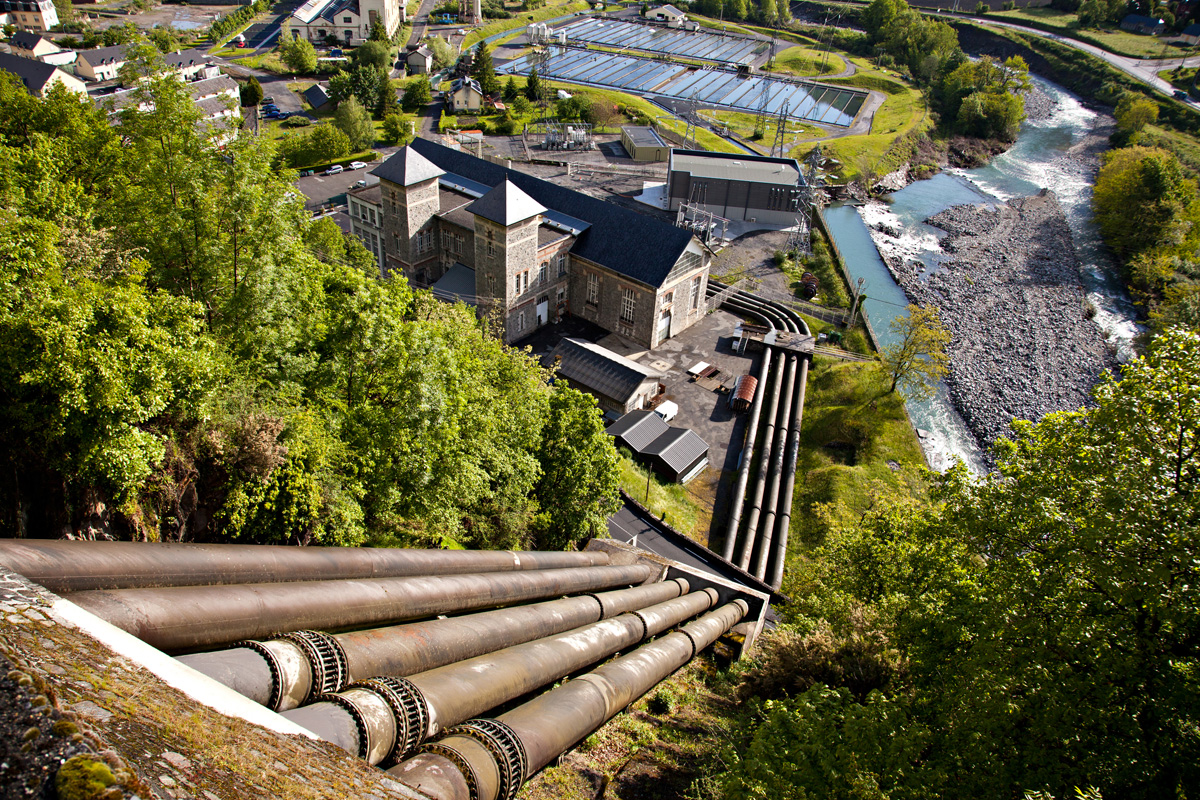
Penstocks are long steel pipes that convey water from dams to power plants. These critical infrastructures represent a major safety and performance challenge for hydropower operations.
SHEM operates in mountainous regions in southern France, where it manages 55 km of penstocks with diameters ranging from 600 millimetres to 2 metres. The maintenance programme includes external visual inspections and in-depth internal inspections to assess deformation, corrosion and the remaining steel thickness.
Historically, these inspections have been carried out by rope-access technicians entering the penstocks. Although this proven method is effective, it presents several limitations: confined spaces, the presence of asbestos, very high temperatures inside the pipes during summer (up to 50°C), restricted access points, sections several hundred metres long, and high curvature. All these constraints make certain areas difficult and sometimes even impossible to inspect manually.
To address these challenges, SHEM launched a testing programme using first underwater robots, and later aerial robots.
In 2023, SHEM carried out an initial test using an ROV in a penstock with a diameter of 800 mm, aiming to reach a distance of 400 metres from the insertion point.
The robot was equipped with an optical camera and an acoustic camera, but did not yet include an ultrasonic sensor for wall thickness measurement.
While the results were encouraging for real-time visual inspection, several limitations were identified:
Ultimately, the robot did not meet the expected objectives.
In 2025, SHEM tested an aerial robot developed by the company OMS, in partnership with Laborelec, one of ENGIE R&I’s research centres.
The test was conducted in a riveted penstock with a diameter of approximately one metre.
The robot was equipped with two tripods allowing it to adapt to diameters ranging from 400 mm to 1.5 m, and carried:
Initial results were promising. The video footage clearly revealed local deformations in the pipe. The laser profilometer accurately measured the local geometry—particularly rivet heads—and made it possible to estimate the depth of certain corrosion cavities.
However, to make full operational use of these data, they now need to be correlated with direct measurements of steel thickness.
The next phase of the project, planned for 2026, aims to test a contactless thickness measurement technology: EMAT ultrasound (ElectroMagnetic Acoustic Transducer).
This technique generates ultrasonic waves using a magnetic field, without any physical contact or liquid couplant—an innovation particularly well suited to complex environments such as penstocks.
Laboratory tests have shown very promising results. The objectives are now to:
This development will be carried out jointly by Laborelec and OMS, with the ambition of creating a benchmark solution for the automated inspection of hydropower infrastructures.
At SHEM, we are keen to develop partnerships with internal operational or service entities, as well as with external companies, to further develop and commercialise this solution.