/
My account person ENGIE

My notifications

News See all the news
Drones to Optimize District Heating Networks

Drones to Optimize District Heating Networks

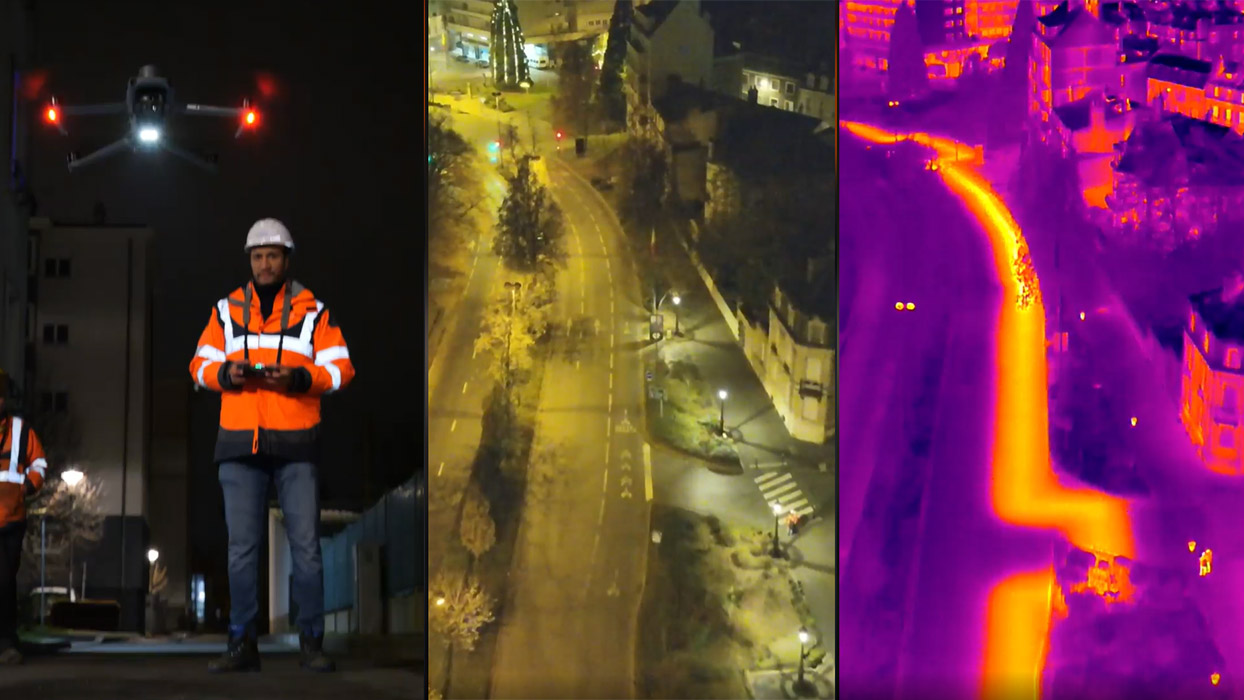
District heating networks face major challenges to which drones and robots bring innovative solutions. Aimane Benhaddou, Head of the GIS Drone & Acoustic Monitoring Unit for leak detection on ENGIE’s district heating networks, presents an innovative solution combining drone-based infrared thermography with electro-acoustic monitoring. This integrated approach makes it possible to map thermal losses and precisely locate leaks on district heating networks.

ENGIE created an internal team of DGAC-certified drone pilots and equipped itself with thermal drones.

Why this solution?

District heating networks face two major challenges that result in both economic losses for ENGIE and significant environmental impacts:

  • Hot water leaks, caused in particular by ground movement or corrosion, sometimes extending over several tens of meters.
  • Degradation of pipe insulation, leading to heat losses and reduced network efficiency.

Since these infrastructures are buried, it is essential to accurately identify the source of the issue before any excavation work. This level of precision helps avoid costly and intrusive works. ENGIE LEI operates district heating networks that are exposed to leaks, insulation defects, and corrosion phenomena. Traditional leak detection methods, such as helium injection, are time-consuming, expensive, and sometimes unreliable.

To meet this growing need, ENGIE created an internal team of DGAC-certified drone pilots and equipped itself with thermal drones. With support from CRIGEN, and notably Erwin George, the drone unit has been operating nationwide for the past three years.

How it works

Drones carry out aerial thermographic inspections to identify suspicious areas. GIS mapping data (depth, pipe diameter, valves, historical data, etc.) enable highly accurate signal analysis. Since 2025, this analysis has been complemented by acoustic monitoring and correlation, which confirm the exact location of leaks on the ground.

Result: a 90% reliable leak localization, transmitted directly to field teams.

Key benefits

  • Lower cost compared to external service providers
  • Leak detection within a few hours (versus several days previously)
  • Immediate results and on-site interpretation
  • 100% in-house solution: expertise, pilots, and equipment
  • Enhanced safety
  • A fast-growing activity

Key figures:

  • More than 10 flights carried out in under three months
  • Significant financial savings for district heating networks
  • Reduced environmental footprint

An innovation serving energy performance

This solution makes it possible to:

  • Reduce water and energy losses
  • Improve network efficiency
  • Lower maintenance costs
  • Avoid intrusive and expensive excavation works

It fully contributes to ENGIE’s Net Zero Carbon 2045 objectives. This approach can be deployed across all district heating networks in France and, subject to regulations, internationally.
Other news on related topics

Loading...