
Jeremy Hellot
Maintenance engineer
ENGIE Green
At ENGIE Green, maintenance engineer Jeremy Hellot and his team recently tested three promising solutions that have been developed with external partners, with a clear objective: to make inspections faster, safer and more reliable. These solutions cover three key areas: inspection of lightning protection, pitch angle measurement and internal inspection of blades.
Each wind turbine blade is fitted with a steel conductor that extends from the root to the tip. Its role is essential: to safely divert the lightning when it strikes the blade. If this system fails, the blade can be directly affected, leading to repairs that could cost up to €50,000 or, in the most serious cases, complete replacement of the blade.
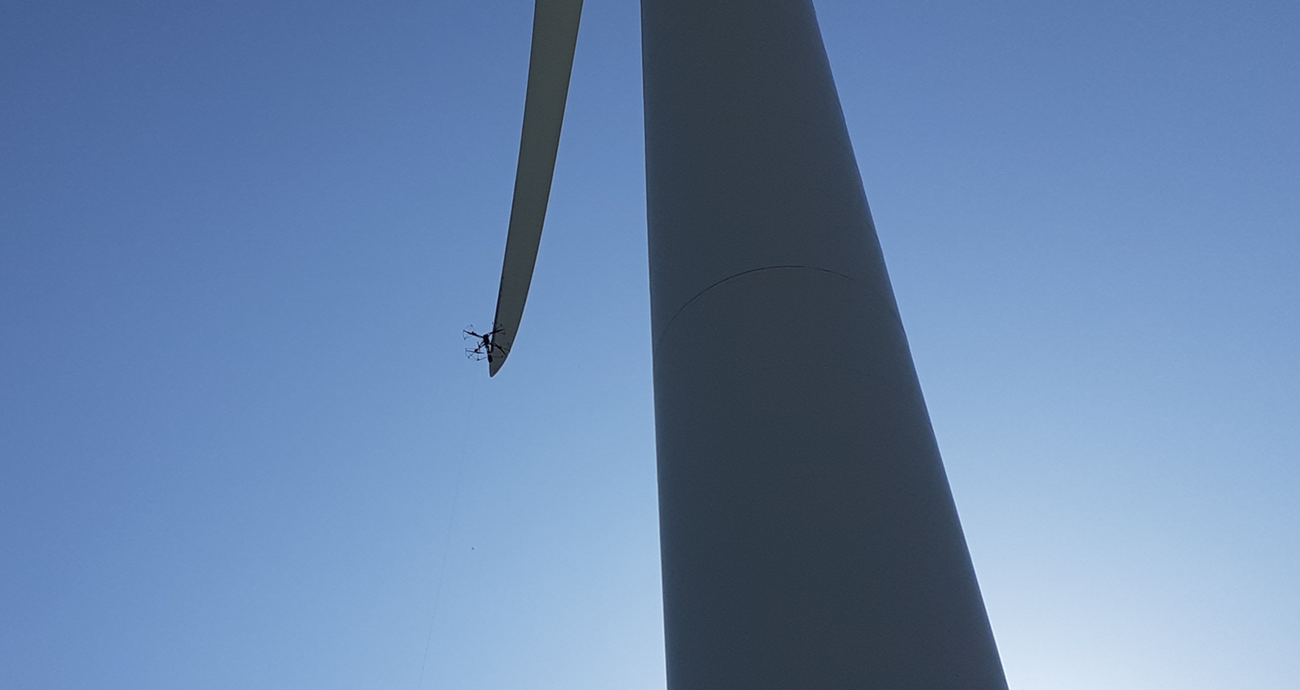
Traditionally, these inspections are carried out by rope access technicians, a complex and time-consuming operation. In 2020, ENGIE Green encouraged manufacturers to develop a drone solution. SupAirVision, a French start-up, has risen to the challenge.
Operating principle:
A drone flies up to the blade receiver, connects a cable to it and measures the electrical resistance up to the turbine earth. If the circuit is continuous, the protection system is operational. If there is no continuity, investigations and repairs are necessary.
Operational impact
The lightning protection of each wind turbine must be tested every five years. The drone speeds up inspections considerably:
Once faults have been detected, only suspect blades are re-checked by technicians, reducing workload and speeding up repair campaigns.
Developed by Alpha Wind, the Dragon Sky drone can accurately measure the pitch angle, the mechanism that orients the blades to capture the wind or stop the turbine.
An incorrect angle leads to aerodynamic imbalance, which can:
The main causes are incorrect factory setting or gradual mechanical drift. Internal sensors in the wind turbines detect imbalances in advance, so those turbines are pre-selected for inspection.
Operational benefits
Dragon Sky measures the actual angle of each blade and calculates the correction to be applied. It can compare all the turbines in the same wind farm in a very short space of time, improving precision and consistency.
The next steps include the integration of DCAS data, or even Darwin data at one-second intervals, to take account of the point-in-time angle of the blades during measurement.
Internal damage to the blades is difficult to detect and generally requires inspection by technicians who physically get inside the blade (annual inspection recommended). This method has several limitations:
To improve the robustness of inspections, ENGIE Green and Crigen’s Drone Lab tested Multinnov’s Stereo 2 drone, combined with Wind Power Lab’s analysis tools.
Test results
Difficulties encountered
Despite these limitations, there is huge potential. With further development, a fully automated internal inspection flight could reduce inspection time to 5 to 7 minutes per blade, generating major operational gains.
The trials carried out by ENGIE Green demonstrate that robotics and drones are no longer exploratory concepts, but actual operational tools that can improve the safety, performance and reliability of wind turbine maintenance. By combining technological innovation, expertise in the field and targeted partnerships, these solutions pave the way for better and faster inspections that are better targeted and progressively automated, to ensure safer and more efficient operation of wind farms.