
Alberto Mian
CEO
ExerGo

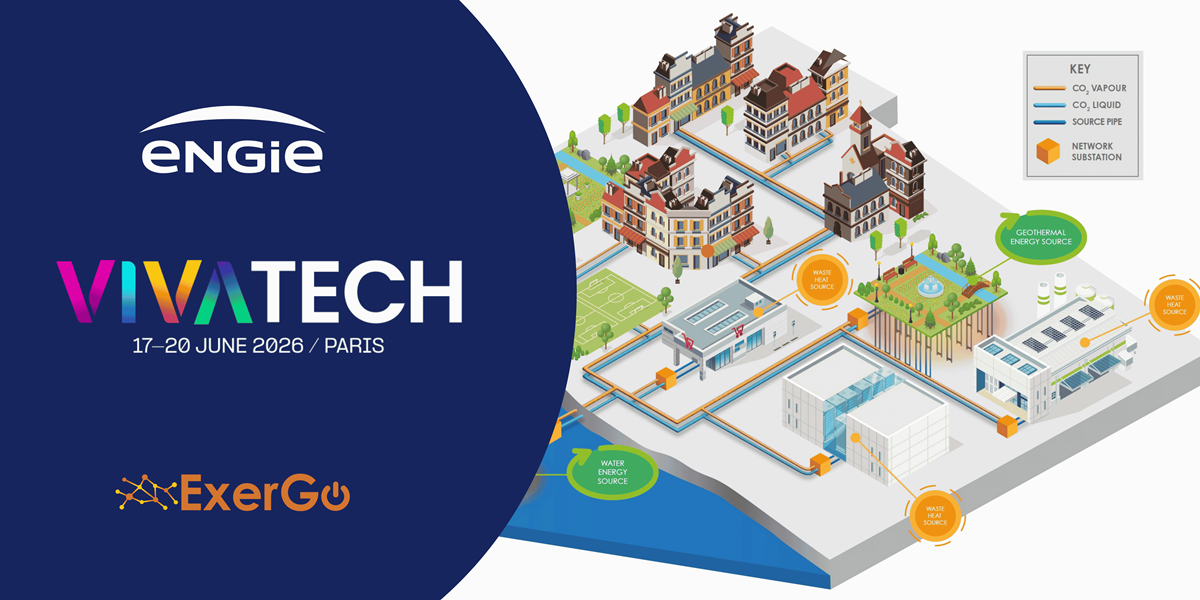
A CO₂ network can simultaneously supply heating and cooling needs, balancing supply and demand among users throughout the year.
My name is Alberto Mian, and I am the CEO of ExerGo. Founded in 2018, ExerGo is a Swiss startup specialized in technologies for urban heating and cooling networks. Our mission is to contribute to the energy transition and to the decarbonization of heating and cooling systems by offering a solution that efficiently captures and distributes energy from natural resources or waste heat to supply heat pumps and cooling units.
We simplify the deployment of heating and cooling networks by enabling the efficient transport of heat or cold extracted from the environment (lakes, rivers, air) to heat pumps, in situations where traditional infrastructures are too heavy, too costly, or physically impossible to install. In doing so, we make the energy transition possible where it was previously blocked by technical or financial constraints.
Our technology uses CO₂ in a closed loop as an energy carrier, allowing large amounts of thermal energy to be transported through small diameter, flexible, and easy to install pipes. This significantly reduces capital expenditure, minimizes the energy required for heat transport, and facilitates both the deployment and renovation of renewable thermal infrastructures.
A CO₂ network can simultaneously supply heating and cooling needs, balancing supply and demand among users throughout the year.
ENGIE is our Series A investor and strategic partner. We chose to collaborate with ENGIE because of its recognition of our innovation potential in the energy sector and its strong commitment to the energy transition. Thanks to the funding round and collaboration agreement with ENGIE, we can continue deploying reference projects in Switzerland while expanding across Europe, starting with France and Germany.
We will present our CO₂ based thermal network technology and its concrete applications for the decarbonization of urban buildings. The key message we want to convey is that ExerGo’s CO₂ loops represent a new industrial standard, now available to the thermal networks market. It is a technology designed to work in synergy with other heating and cooling network solutions.
Today, the “intelligent” aspect of our network relies on a real time monitoring and control system that optimizes CO₂ flows, temperature, and pressure throughout the network. This is a crucial first step: without continuous supervision, it would be impossible to guarantee the performance and safety of a CO₂ thermal network.
At ExerGo, we see AI not as an end in itself, but as a leverage to maximize the value of our physical technology. Impact, not illusion—that perfectly reflects our approach.
Our next challenge is to move from technological validation in Switzerland to large scale deployment across Europe, where we now need to demonstrate the reproducibility of our solution in different markets, particularly in France and Germany.
Our entire team and our investors are working to make CO₂ loops the new industrial standard. In five to ten years, our goal is to make this technology accessible to energy providers and cities, enabling decarbonization projects that were previously unviable to become both technically and economically feasible. This would allow many more communities to heat and cool buildings using low impact solutions, in a model that promotes the responsible use of natural resources.
To give one concrete figure: thanks to the use of heat pumps connected to our CO₂ system, the industrial project currently under development in Switzerland with the energy utility GroupeE alone is expected to avoid around 11,000 tonnes of CO₂ emissions per year.