

Check out the DH Octopod project
at VIVATECH with the
Lab Cylergie

Our way of doing research is to get to the bottom of things, while keeping an eye on the bigger picture. Gaël Berger
DH Octopod radically changes the way modern heating networks are designed and regulated. We put a few questions to Gaël Berger, a key player in the project at Lab Cylergie, at the crossroads of supplier, business unit and R&I.
Heating networks are among the most environmentally friendly solutions for providing heating and hot water for a district or town. But one challenge remains: not all buildings require the same temperature.
In a conventional network, the temperature is uniform, resulting in:
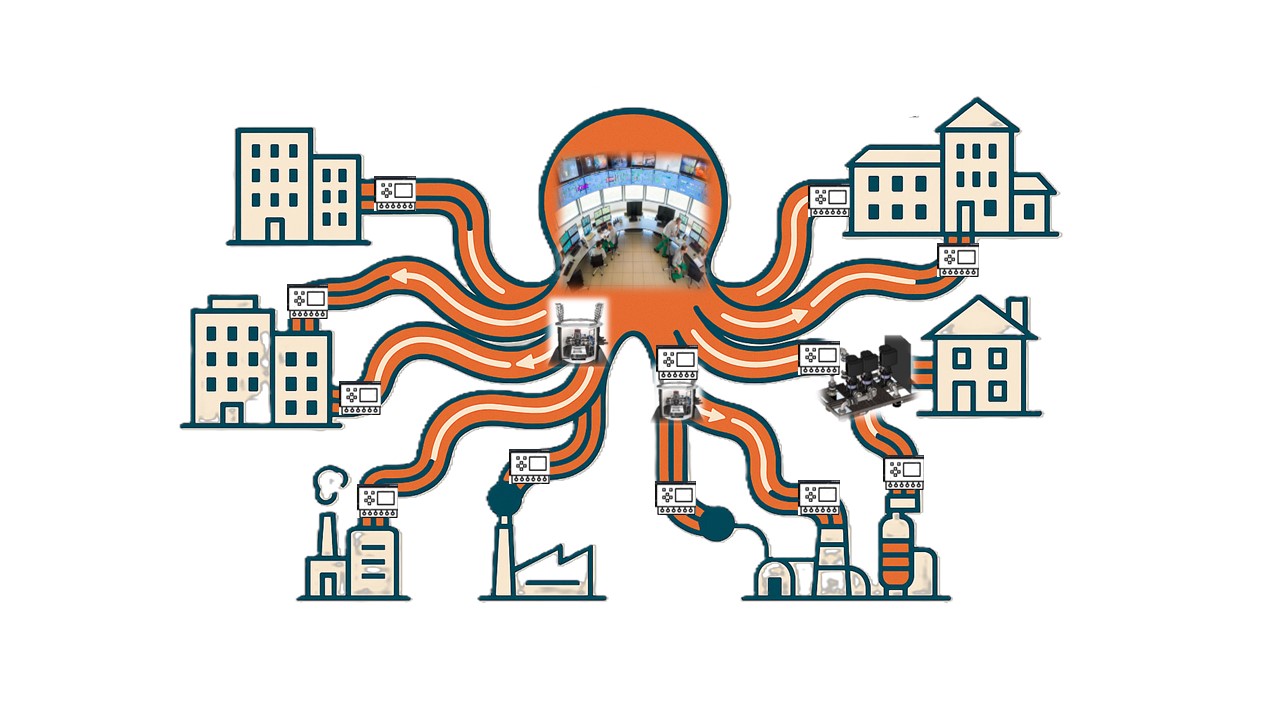
Lab Cylergie, one of ENGIE’s research centres, has identified an ambitious solution: isolate a branch of the network in order to distribute a lower temperature, adapted to actual needs. The aim is to demonstrate that decentralised regulation can radically transform network operation.
For several years now, the Group and R&I have been working on solutions to significantly lower the return temperature of networks.
Cylergie had established that a major lever was located at substation level, but above all at network branch level.
The technology to make this possible was identified at Grundfos, with whom ENGIE – and ENGIE Solutions in particular – was developing a partnership.
Thanks to the support of Alexis Goldberg, sponsor of the partnership, we decided to launch a pilot directly on the Plateau Nord network.
This project is therefore part of a continuum of work that has been going on for a long time.
DH Octopod controls the temperature and flow of water sent to the 15 test substations using a coherent set of four technological building blocks:
1. Hydraulics
Pumps, valves, non-return valves and piping mix hot and warm water to precisely adjust the temperature delivered.
2. Electromechanical
A pump equipped with a variable-frequency drive motor (IE5), a differential pressure regulator and a set of sensors ensure that the loop created operates optimally and flexibly.
3. Instrumentation and control
A dedicated PLC controls the mixture, applies a heating curve and anticipates peaks in demand to guarantee comfort and performance.
4. Communication
Currently connected via a SIM card, the solution will soon switch to secure Ethernet (TCP/IP) communication, in line with European cybersecurity standards.
A heating network is based on three elements: production, network and substations. Tests carried out at substation level alone resulted in a gain of 1 to 2 °C, which was still not enough.
With Octopus Grid, the impact is much greater: 10 to 15 °C saved on a single installation, by adding intelligence to the network branches. Current measurements show a gain of 10 to 12 °C, with even greater potential thanks to ongoing optimisation.
The project is currently being tested on the Plateau Nord heating network in Lyon, a strategic site for ENGIE Solutions.
This location was chosen for several reasons:
As a genuine open-air laboratory, this site offers the ideal conditions to evaluate DH Octopod under representative and varied operating scenarios prior to wider rollout in France and Europe.
These technological objects are both new and complex. We modelled them in our in-house software to support their analysis.
I see this project as the work of a transmitter of science: understanding, analysing, testing, adjusting... then demonstrating that it works. We examined the technology proposed by Grundfoss (iGrid), optimised its integration, adjusted several parameters and quantified the operational gains. This applied research approach enables us to answer a key question: how can we make the most of an innovation, even if it wasn’t designed internally?
Our way of doing research is to get to the bottom of things, while keeping an eye on the bigger picture. On this project, we had to adapt a technology designed for Northern Europe to the French regulatory and operational context. We act as a bridge between design, construction and operation – three professions that are often siloed. Many innovations fail because everyone only sees their part.
In this case, we were involved in all phases of the project, which meant that it was completed in less than 9 months, which is a real success.
For 2026, we’re looking at how to industrialise the solution. The aim is to equip around thirty sites by the end of the year or in 2027. The potential for deployment is therefore very significant.
DH Octopod is fully in line with ENGIE’s strategy of deploying smarter, more efficient and more sustainable infrastructures.