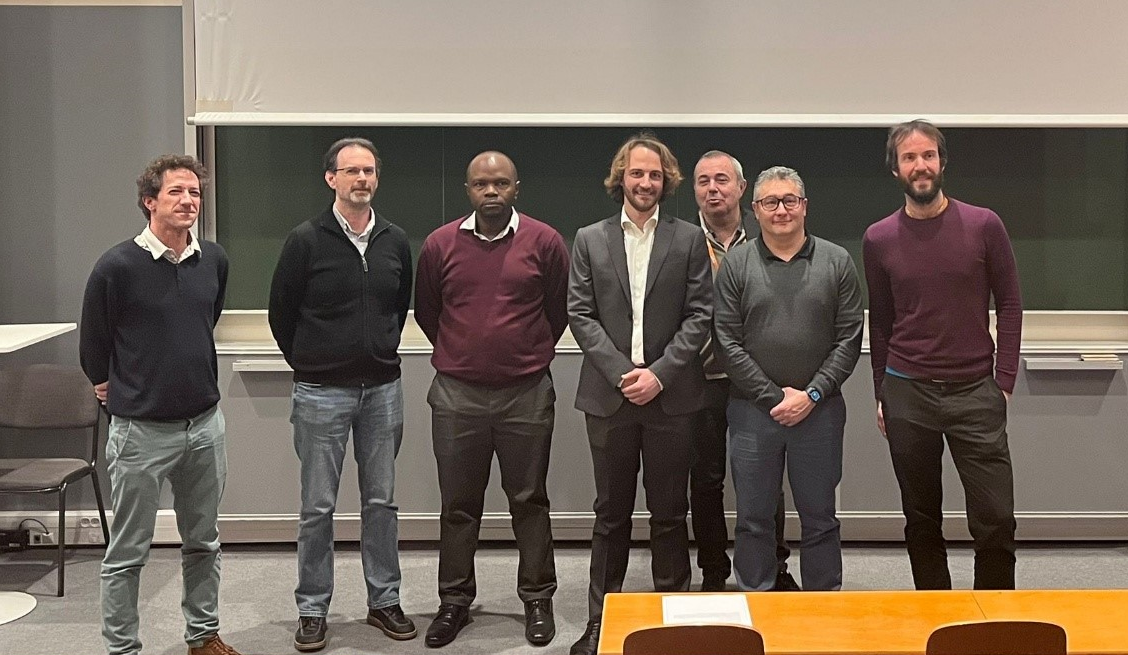


Few PhD students manage, in just three years, to do what Nicola has done, to put together a tool that covers physics, economics and decision-making support. Dr Thomas Guewouo
I’m an engineer specialising in the energy sector and I’ve just completed my PhD thesis in collaboration with Lab Crigen and École des Mines d’Albi.
My journey began in Italy in 2014 at the Faculty of Energy Engineering at the University of Padua, my hometown. I went into this field because, over the years, I had developed a particular interest in climate change, so I decided to devote my studies to tackling its causes.
During my training, I came to understand the importance of the energy transition and the technological and industrial development needed to support it. At the end of my Master’s, I was looking for an opportunity abroad to broaden my skills and horizons, and I was immediately drawn to ENGIE’s offer of a work-study contract in the field of hydrogen mobility. This project gave me the chance to apply the skills I had acquired during my studies to work on a technological innovation aimed at reducing the climate impact of the transport sector.
My PhD thesis is about optimising the design of refuelling stations for heavy-duty hydrogen vehicles. Heavy-duty fuel cell vehicles promise to drastically reduce greenhouse gas emissions from road freight transport, which currently accounts for 6% of total emissions in Europe, but it is still an emerging technology. One of the main obstacles to its diffusion is the development of a distribution infrastructure that will enable lorries to refuel safely and at low cost.
To meet this need, we have developed a new refuelling station design methodology, based on thermodynamic and economic modelling of the station and its components. This method, integrated into a tool called HyFill, makes it possible to identify the optimal configuration of the station, that is to say, to choose the components that will ensure the supply to customers at the lowest possible cost.
At the end of my work-study year, I had the feeling that I’d barely scratched the surface of a subject with much greater potential. When my supervisors, Quentin and Thomas, suggested that I stay on with a CIFRE PhD contract, under which I would be able to define the project objectives myself and choose the academic research group that would support us throughout the thesis, I accepted.
It was a unique opportunity for me to be able to work on a research project that I was passionate about, while determining its direction and ambitions. Indeed, the thesis allowed me to work closely with the very best in scientific and industrial research, and pushed me to progress both in terms of scientific and methodological discipline and R&D project management, where tangible results are expected.
What’s more, I’d been pleasantly surprised by the work environment I’d seen at Crigen, with its stimulating setting that was conducive to professional growth through collaboration with highly competent people.
For me, writing a PhD thesis is an essential step in the life of a researcher, whether in the academic world or in industry. Publishing a thesis poses challenges that no other path offers.
First of all, a PhD means, by definition, pushing the boundaries of research and therefore of knowledge: a PhD student explores new, uncertain territory, where results are never guaranteed, even if expectations – particularly of yourself – are often very high.
Embarking on a project of this kind means learning how to manage a complex process, plan your deadlines, deal with the unexpected, reformulate your hypotheses when necessary and stay motivated even when the results are slow in coming.
At the same time, doing a thesis allows you to grow both as a researcher and as a professional: learning to be scientifically disciplined, to work methodically, to interact with highly competent experts and to communicate your results clearly and convincingly.
It’s an in-depth training programme, because it’s not just about learning something. Above all, it teaches you how to learn, how to tackle new problems and how to build robust, innovative solutions.
Finally, the thesis is important to me because it represents a unique opportunity to make a real contribution to technological progress in the energy sector, which I consider central to the future of the planet. Knowing that my work can have a real impact on the energy transition was the main motivation for me to embark on this journey.
Nicola joined us just over three years ago as part of the Hydrogen Lab’s hydrogen mobility team. He is working on an issue that is crucial for the Group: the technical and economic optimisation of hydrogen refuelling stations for heavy-duty transport. This is still a young, technically demanding field where standards are under development and where each engineering choice can have a direct impact on CAPEX, OPEX... and on the competitiveness of hydrogen per kilogram distributed at stations.
What quickly strikes you about Nicola is his discipline and scientific curiosity. As soon as he joined the team as a work-study student, he showed an interest in thermodynamic modelling, quickly picking up the building blocks of the in-house tool (HyFill), which is used for the thermodynamic simulation of hydrogen refuelling stations (HRSs) currently being developed by the team. As a result, he was able to suggest ways of improving the tool, which made him the ideal candidate for the thesis we wanted to launch to accelerate the development of the tool and support the Group in its ambition to become a major HRS operator in France. A CIFRE thesis was therefore established between Lab Crigen and IMT d’Albi, launched in January 2023 and defended in December 2025. That’s three years of continuous effort during which Nicola has shown remarkable consistency. He has carried out thermodynamic modelling, developed an AI model to speed up thermodynamic property calculations, performed techno-economic analyses and then optimised everything using the genetic algorithm. Few PhD students manage, in just three years, to do what Nicola has done, to put together a tool that covers physics, economics and decision-making support.
Today, I can say that Nicola has become the go-to person for these subjects. A motivated and extremely independent young researcher, who understands both the details of a thermodynamic system and a hydrogen station and the strategic challenges of the heavy-duty hydrogen mobility sector. For us at the Hydrogen Lab, it has been a pleasure and we are genuinely proud to have supported him on this adventure.
First of all, I think that a thesis should never be something you just fall into. It’s an intense, demanding and sometimes trying commitment. You have to be willing to dig deep into a subject, to go beyond what you already know, and to accept that research sometimes progresses in small victories. If you have this desire, a thesis is probably one of the richest experiences of your professional life.
While working on a thesis, you have a luxury that you rarely find: the time to really learn, to explore a subject in all its dimensions. You gain a way of working, an autonomy and a scientific maturity that will stay with you for the rest of your life. You’ll discover communities, conferences and sometimes experts in your field from all over the world. And above all, you become a specialist. Not just in a tool or technology, but in a coherent body of knowledge that you have helped to build.
Because it’s a unique place.
Here, we do applied research, but without losing our scientific depth. We work on issues that have an immediate impact: the energy transition, low-carbon gases, and the industrial infrastructure of tomorrow. Every project, every model, every simulation can have a direct impact on an investment or restructuring decision within the group.
Crigen also boasts a rare diversity: engineers, researchers, PhDs, industry experts... We discuss thermodynamics, optimisation and modelling more generally, as well as European standards, industrial strategies and field operations. We stay close to the Group’s needs, while having the intellectual freedom to innovate.
Finally, there’s the famous Lab Crigen mindset: a place where you’ll be in good company. PhD students don’t just sit in a corner. They are part of the teams, at the heart of projects, in contact with experts who share their experiences and enjoy passing on their knowledge.
To sum up, if a young researcher is in two minds: a thesis is an opportunity to spend three years becoming a real expert, making enormous progress and contributing to real-world issues. And at Crigen, you can be sure of doing so in a demanding, caring environment that is directly linked to the Group’s energy transition.
Thank you, Thomas and Nicola, for your inspiring answers, and congratulations once again, Nicola, on your incredible success, which we’re sure is just the beginning of a series of achievements in the service of the planet’s future.